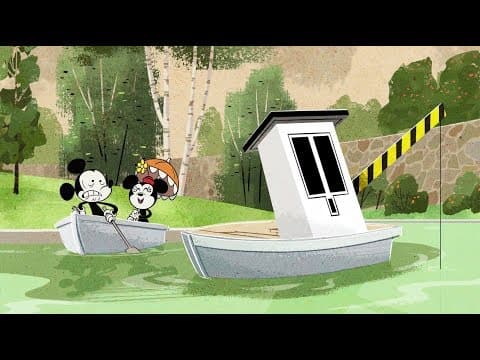
Pronunciation ChallengeFor Whom the Booth Tolls | A Mickey Mouse Cartoon | Disney Shorts
Host : Steve
0
0
0
Check out a new pronunciation challenge based on a clever and comedic Mickey Mouse short film.
0:000:00
Check out a new pronunciation challenge based on a clever and comedic Mickey Mouse short film.


EmmaGo6 years ago
Hello and welcome to the new pronunciation challenge everyone! This’s your host, Steve. And I‘ve been reading your comments and getting to talk to a lot of you, which is very awesome. And some of you have said that my episodes have been a little bit too fast, so I hope I can slow down a little bit so everyone can understand.
Today’s sentence comes from a Mickey Mouse video. Cartoons are actually really popular in the USA. A lot of kids watch [[stuff like]] Nickelodeon, Cartoon Network or Disney. Now I really actually like cartoons. I’m pretty excited to watching Frozen Two when it comes out, I have to admit. But sometimes as an adult, we can’t really watch cartoons so a pronunciation challenge could be a really good opportunity to watch and talk about cartoons.
When I was a kid, I actually didn’t watch Mickey Mouse that much. I liked [[Looney Tunes]], I really like Bugs Bunny, and my favorite was actually Tom and Jerry, maybe you know it, it’s about a cat and a mouse, and the mouse always has tried to run away and fights the cat, and the mouse always wins. I also really like South Park, which is more [[of an adult]] cartoon, I thought it was really funny even though I didn’t understand the jokes, but now it is, I actually still watch South Park and I find it to be very funny and it talks about real life stuff. So I think there’s something amazing [[about]] while watching cartoons, and I think [[they’re a great]] directly way to get a creative boost and they can also help our imaginations expand and [[also, of course]] makes us happy.
Anyway, let’s move on to today’s challenge. Here is the sentence: Excuse me. I still owe you some more change.
Okay, let’s talk about the pronunciation. Whenever you say “excuse me.” to somebody, you should take a short pause after you say it.
Excuse me! Where are you going?
Excuse me! How could I get to the MRT?
Excuse me! Where is the bathroom?
So there should be a short pause after you say “excuse me.”
The other thing to know is the word “still”. I still owe you some more change. Maybe you notice that still is a little bit stronger here. We say it a little bit more loudly. Because we’re emphasizing that something that should have or could’ve been done, is not done. Or that something still needs to happen. So when we say “still”, we often say it more strongly than one of the words in the sentence.
So listen one more time. “Excuse me. I still owe you some more change.” Hopefully you can hear that short pause after “excuse me” and the emphasis on “still”.
Alright, now it is vocabulary time.
1. excuse [ɪkˋskjuz] (v.) 原諒;寬恕
It means to regard or judge with forgiveness or indulgence([ɪnˋdʌldʒəns] n.寬容); pardon or forgive; overlook([͵ovɚˋlʊk] n.寬容).
* Please excuse my lateness. The traffic was so bad today.
So l’m late because of the traffic. So I want [[?]] excuse my because it’s not my fault. I wouldn’t have been here on time because the traffic was really bad, so please excuse my lateness.
* Can you excuse her? She just threw up.
So she got sick and she threw up, and so maybe somebody wants to talk to her or needs her for something, so you’re asking please excuse her, leave her alone right now, she just threw up, she’s sick.
2. owe [o] (v.) 欠(債);欠(帳);該償還
It sounds just like the letter O in the ABCs. But you can say the slight w sound like [o]. iOS you some change. So the definition is to be under obligation([͵ɑbləˋgeʃən] n.義務,責任) to pay or repay.
* You got me a beer last night. I still owe you money for that.
So you bought me a beer last night, and I did not pay you last night, so now I still owe you money, I need to give you the money for last night’s beer. I owe you that money.
* I still owe Johnny three hundred dollars.
So you need to give Johnny 300 dollars. For what? We don’t know. But Johnny gives you 300 dollars or something that is equal to 300 dollars and now you owe him that money back. So when you owe someone money, you’re basically just paying somebody back for something that they gave you before. One thing to know is that you don’t need to have the word “still” when you use “owe”. I know we just went through two examples that have the word still, “I still owe you “ or “I still owe Johnny”, but you don’t need that. I could just say “I owe Johnny 300 dollars.” The still makes it more strong and shows that might be a longer time like “I still owe Johnny 300 dollars.” Maybe you haven’t paid it back and it’s really important, and you want to do it soon. As you saying “Hey, I still owe him money, I need to make sure I pay him, and don’t forget.” But you don’t need “still”. You could just say something like “I owe him 300 dollars.“ or “Do I owe you 300 dollars for that beer?”
3. change [tʃendʒ] (n.)找零
Change has a lot of meanings, this’s a noun form, referring to money. So here is the definition: A balance of money that is returned when the sum([sʌm]n.總數) tendered in payment is larger the sum due. If you don’t understand that, that’s okay, let’s go through an example and break it down.
* That water is thirty cents, and you gave me one dollar, seventy cents is your change.
So change is the money you get back. Maybe you go to 7-11, and you buy a piece of bread for 30 cents, you gave the cashier one dollar, so 100 minus 30 is going to be 70, so you get 70 cents in change back. If you go to a restaurant, that costs 25 dollars, and you gave them to dollars, you should get 25 dollars in change back. That is the change they owe you.
Well, that’s it for today’s vocabulary and pronunciation. Let’s talk about cartoons for just seconds. Now I used to actually watch a lot of Peppa Pig or 佩佩豬 in Chinese last year. I was studying in Chinese and I thought that listening to Peppa Pig would be a good way to improve my Chinese listening. Since the vocabulary and grammar is much more simple [[?then maybe what I would find]] on the streets of Taiwan. And I actually watched a lot of Pororo, the penguin in Korea too when I studied in Korean. So I think if you’re a beginner or intermediate English learner, you can watch some cartoons that would be a really good way to boost your listening. Now if your English is really good or you’re an advanced learner, you might need to watch something that’s more complicated or complex.
Well, that’s it for today. I hope you enjoy the episode. Please leave a comment below. You can leave a question, try an example sentence, or tell me which cartoons you enjoy, or which cartoons help you learn a second language. I will try to reply to many of you as I can. See you next time. Cheers!
陸毅坤6 years ago
Marcos6 years ago
spanish.
if someone can speak English,chinese and spanish, he can take the world!!
Chu Thuy Quynh Anh6 years ago
bad guy6 years ago
Day 6
minjane dinh6 years ago
江秉哲6 years ago
おはよう、Steve I hope you have a great Tuesday.
bingo66 years ago
levi2 years ago
Dao Nguyen5 years ago
91