adverb
US /ˈædvɜ:rb/
・UK /ˈædvɜ:b/
Video subtitles
Iceland prepares for volcano: BBC News Review

- Yeah, because we often use this to talk about the way we do things, we can use the adverb 'frantically' to describe things done in a hurry because you're worried or scared.
Yeah, because we often use this to talk about the way we do things, we can use the adverb 'frantically' to describe things done in a hurry because you're worried or scared.
- we can use the adverb 'frantically' to describe things done in a hurry
we can use the adverb 'frantically' to describe things done in a hurry
Describing and Comparing Things Using AS and AS in English

- So in English, we sometimes use the word as, and we put an adjective or adverb, and then we put another as, and we say things like "as flat as a pancake."
So in English, we sometimes use the word as, and we put an adjective or adverb, and then we put another as, and we say things like "as flat as a pancake."
- put an adjective or adverb, and then we put another as,
put an adjective or adverb, and then we put another as,
BOX SET: English In A Minute 5 – TEN English lessons in 10 minutes!

- Here, 'fine' is an adverb of manner because it indicates doing something in a satisfactory manner.
Here, 'fine' is an adverb of manner because it indicates doing something in a satisfactory manner.
- In this sentence, 'finely' is an adverb of degree, and it describes how small something needs to be cut up.
In this sentence, 'finely' is an adverb of degree, and it describes how small something needs to be cut up.
BOX SET: English In A Minute 7 – TEN English lessons in 10 minutes!

- We use 'very' to make an adjective or an adverb stronger.
We use 'very' to make an adjective or an adverb stronger.
Iran's president killed in crash: BBC News Review

- And we also have the adverb furtively. If someone acts furtively,
And we also have the adverb furtively. If someone acts furtively,
BOX SET: English In A Minute 6 – TEN English lessons in 10 minutes!

- This sentence follows normal word order. Subject + auxiliary verb + adverb + verb.
This sentence follows normal word order. Subject + auxiliary verb + adverb + verb.
- 'Never' is a negative or limiting adverb. Other examples are 'rarely', 'hardly' and 'not often'.
'Never' is a negative or limiting adverb. Other examples are 'rarely', 'hardly' and 'not often'.
Words to make yourself more interesting

- you're using this adverb.
you're using this adverb.
- The sentence I'm thinking of, you'd say something is too expensive as in "too much", ok? For a negative when you're using this adverb.
The sentence I'm thinking of, you'd say something is too expensive as in "too much", ok? For a negative when you're using this adverb.
Learn English: Words with many meanings

- -- it could be a noun, an adverb, an adjective, and a verb. But for most of you guys, you
-- it could be a noun, an adverb, an adjective, and a verb. But for most of you guys, you
English Grammar: Negative Prefixes - "un", "dis", "in", "im", "non"
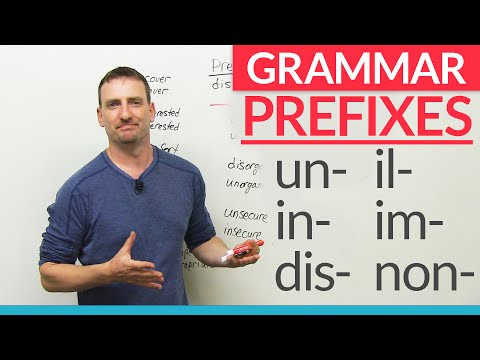
- a word that comes before the main word; can come before an adjective, before an adverb,
a word that comes before the main word; can come before an adjective, before an adverb,
Basic English: Learn the difference between BECAUSE and SO

- There's another difference with "so" that I like. That should help you with them. "So" is also an adverb.
There's another difference with "so" that I like. That should help you with them. "So" is also an adverb.
- And that tells me the range. What we have here is verb plus "so". And that's how we show the adverb, how it works together.
And that tells me the range. What we have here is verb plus "so". And that's how we show the adverb, how it works together.