squat
US /skwɑ:t/
・UK /skwɒt/
B2TOEIC
v.i.Intransitive VerbTo illegally live on anothers property or land
They left that building to squat in this one
v.i.Intransitive VerbTo sit on your heels
I will squat down so I can talk to the dog
n.NounExercise consisting of sitting on your heels
I want to see you do a squat
Video subtitles
Learn 60 English Action Verbs In Under 10 Minutes! Acted Out For Easy Memorization!

- You can also squat and look at something on the ground and if you're playing a game like soccer, you can kick the ball.
You can also squat and look at something on the ground and if you're playing a game like soccer, you can kick the ball.
- You can also squat and look at something on the ground.
You can also squat and look at something on the ground.
When You Think the Personal Trainer Likes You

- Anyway, um, that's the free weights, let's move on to the squat racks.
Anyway, um, that's the free weights, let's move on to the squat racks.
- Brian, what's your max back squat, 405?
Brian, what's your max back squat, 405?
A Christmas Carol by Charles Dickens Full Audiobook with Subtitles and Chapters

- There were Norfolk biffins, squat and swarthy, setting off the yellow of the oranges and lemons,
There were Norfolk biffins, squat and swarthy, setting off the yellow of the oranges and lemons,
- there were Norfolk Biffins, squat and swarthy, setting off the yellow of the oranges and lemons,
there were Norfolk Biffins, squat and swarthy, setting off the yellow of the oranges and lemons,
How To Fix Back Pain (7 Science Backed Steps)
- The most simple way to learn how to hinge is with the short stop squat.
The most simple way to learn how to hinge is with the short stop squat.
- If you need to pick up something heavier from the ground, use this short stop squat, and then drop your hips straight down, grab the object, stick in your core, and stand straight up.
If you need to pick up something heavier from the ground, use this short stop squat, and then drop your hips straight down, grab the object, stick in your core, and stand straight up.
B1 English Listening Practice - The Gym
- Moving on from the benches, you've got another really important station in the gym, the squat rack.
Moving on from the benches, you've got another really important station in the gym, the squat rack.
- If you go to the gym regularly, you'll know that the squat rack is always taken.
If you go to the gym regularly, you'll know that the squat rack is always taken.
Cooper Family Dinners | Young Sheldon

- I ain't upset about Jack Squat.
I ain't upset about Jack Squat.
- I ain't upset about Jack Squat.
I ain't upset about Jack Squat.
Infuriating Behaviors at the Airport

- You squat down. Open your luggage. And start rearranging everything in your luggage.
You squat down. Open your luggage. And start rearranging everything in your luggage.
- You squat down, open your luggage, and start rearranging everything in your luggage.
You squat down, open your luggage, and start rearranging everything in your luggage.
Margot vs Lily – "Beginners" by NikeWomen (2 of 8)

- Squat jumps for 30 seconds.
Squat jumps for 30 seconds.
- APP: Squat jumps for 30 seconds.
APP: Squat jumps for 30 seconds.
Best Exercises for Brain Health, Performance & Motivation | Dr. Andrew Huberman

- And this is really to emphasize the nerve to muscle pathways and the way that time under tension promotes the release of things from muscles into the bloodstream that can positively impact the brain, as well as the way that focusing your brain on exercises such that you're isolating muscles, or even if you're not doing a so-called isolation exercise, maybe you're doing a compound exercise like a dip or a squat or a deadlift, but that really concentrating on the muscles that are supposed to be managing the work and not just moving the weight, but challenging the muscles, this very important thing, challenging the muscles using the weight, not lifting weights or moving weights.
And this is really to emphasize the nerve to muscle pathways and the way that time under tension promotes the release of things from muscles into the bloodstream that can positively impact the brain, as well as the way that focusing your brain on exercises such that you're isolating muscles, or even if you're not doing a so-called isolation exercise, maybe you're doing a compound exercise like a dip or a squat or a deadlift, but that really concentrating on the muscles that are supposed to be managing the work and not just moving the weight, but challenging the muscles, this very important thing, challenging the muscles using the weight, not lifting weights or moving weights.
- And this is really to emphasize the nerve to muscle pathways in the way that time under tension promotes the release of things from muscles into the bloodstream that can positively impact the brain, as well as the way that focusing your brain on exercises such that you're isolating muscles or even if you're not doing a so-called isolation exercise, maybe you're doing a compound exercise like a dip or a squat or a deadlift,
And this is really to emphasize the nerve to muscle pathways in the way that time under tension promotes the release of things from muscles into the bloodstream that can positively impact the brain, as well as the way that focusing your brain on exercises such that you're isolating muscles or even if you're not doing a so-called isolation exercise, maybe you're doing a compound exercise like a dip or a squat or a deadlift,
STOP Doing These Exercises For Low Back Pain!
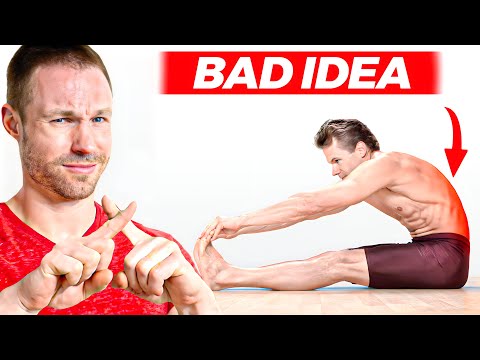
- Instead of stretching the hamstrings, what we want to do is teach from the shortstop squat, something different.
Instead of stretching the hamstrings, what we want to do is teach from the shortstop squat, something different.