present tense
US /ˈprɛznt tɛns/
・UK /ˈprezənt tens/
A2
phr.Phrase
n.NounA verb tense used to describe current actions or states of being.
In the sentence 'I am happy,' 'am' is in the present tense.
Video subtitles
Common English Mistakes With Verb Tenses
- Because we have "tell," which is a present tense verb, right?
Because we have "tell," which is a present tense verb, right?
- Because we have 'tell', which is a present tense verb, right?
Because we have 'tell', which is a present tense verb, right?
AS SOON AS Use in English | Use of AS SOON AS in English Grammar
- It's really important when you use 'as soon as' to use it with the present tense, the present simple, okay?
It's really important when you use 'as soon as' to use it with the present tense, the present simple, okay?
- It's really important when you use "as soon as" to use it with the present tense, the present simple, okay?
It's really important when you use "as soon as" to use it with the present tense, the present simple, okay?
Difference between CAN and ABLE TO ~ Intermediate Level English #englishlessons
- When we use them in the Present tense, in fact, there is no difference.
When we use them in the Present tense, in fact, there is no difference.
- When we use them in the present tense, in fact there is no difference: I am able to, I can means exactly the same.
When we use them in the present tense, in fact there is no difference: I am able to, I can means exactly the same.
Achieve ANYTHING: Powerful Mindset Hacks for Success (2026 Guide)

- Speak in the present tense about your goals.
Speak in the present tense about your goals.
- Here's what you do: eliminate phrases like "I can't" and "I'm broke." Replace them with "I can figure this out" or "I'm building wealth." Speak in the present tense about your goals.
Here's what you do: eliminate phrases like "I can't" and "I'm broke." Replace them with "I can figure this out" or "I'm building wealth." Speak in the present tense about your goals.
English Grammar Practice For ALL Students and Exams

- For our next question, I'd like you to complete the gaps with a form of be in the present tense.
For our next question, I'd like you to complete the gaps with a form of be in the present tense.
- For our next question, I'd like you to complete the gaps with a form of be in the present tense. Everyone here?
For our next question, I'd like you to complete the gaps with a form of be in the present tense. Everyone here?
FLUENT ENGLISH: Understand & Use Contractions like a Native Speaker
- I told you with would, we use the present tense of the verb or the base verb, but if we're going to use had, it's going to be the past participle.
I told you with would, we use the present tense of the verb or the base verb, but if we're going to use had, it's going to be the past participle.
- I told you with "would" we use the present tense of the verb or the base verb, but...
I told you with "would" we use the present tense of the verb or the base verb, but...
3 ways to use 'as long as' - English Grammar
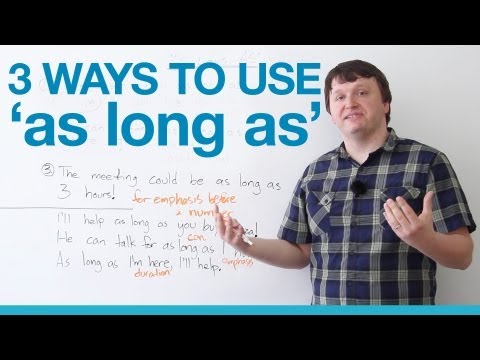
- The reason for this is that we generally use "as long as" in the present tense, okay? So:
The reason for this is that we generally use "as long as" in the present tense, okay? So:
- The reason for this is that we generally use "as long as" in a present tense, okay?
The reason for this is that we generally use "as long as" in a present tense, okay?
Learn English Grammar: has, have, have got
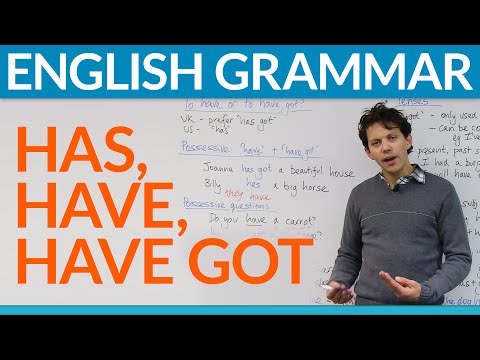
- in the present tense, right now. That dog out there has got rabies, so I'm going to
in the present tense, right now. That dog out there has got rabies, so I'm going to
- It's in the present tense.
It's in the present tense.
How to talk about an article in English

- Another variation of "I thought" or "I think" - you could use the present tense as well - is "In my opinion." "In my opinion" because I know about these things.
Another variation of "I thought" or "I think" - you could use the present tense as well - is "In my opinion." "In my opinion" because I know about these things.
- use it present tense as well, is: "In my opinion". "In my opinion, because I know about these
use it present tense as well, is: "In my opinion". "In my opinion, because I know about these
Learn English Grammar: Reported Speech / Indirect Speech
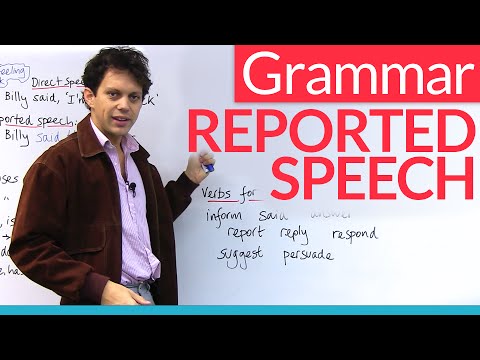
- the inverted commas. Present tense, reported speech, in the past. And we often use "said
the inverted commas. Present tense, reported speech, in the past. And we often use "said
- Present tense, reported speech, in the past,
Present tense, reported speech, in the past,