nonverbal
US /ˌnɒn'vɜ:bəl/
・UK /ˌnɒn'vɜ:bl/
B1
adj.AdjectiveBeing communicated or done without speaking
Her nonverbal communication shows she is happy
Video subtitles
How to Get People to Listen to You | The Harvard Business Review Guide

- Your nonverbal communication can either undermine or elevate what you have to say.
Your nonverbal communication can either undermine or elevate what you have to say.
- Authors Amy Jenn Sue and Muriel Magnan Wilkins use the acronym CENTER to help people remember six key sources of nonverbal communication.
Authors Amy Jenn Sue and Muriel Magnan Wilkins use the acronym CENTER to help people remember six key sources of nonverbal communication.
Body Language: How to tell if someone is bored or interested!
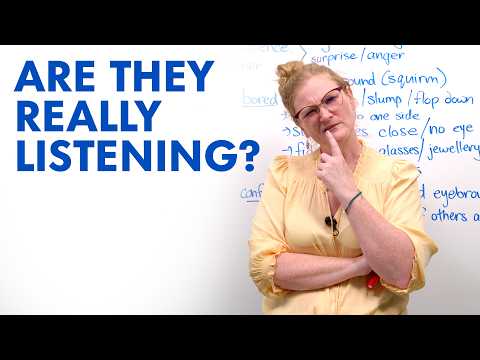
- So, when you're speaking, doing presentations at work, look out for these nonverbal body movement cues.
So, when you're speaking, doing presentations at work, look out for these nonverbal body movement cues.
- So, when you're speaking, doing presentations at work, look out for these nonverbal body movement cues.
So, when you're speaking, doing presentations at work, look out for these nonverbal body movement cues.
Subconscious fluency in English (by Learning at Home)

- Two, use nonverbal clues as much as possible.
Two, use nonverbal clues as much as possible.
- 2, use nonverbal clues as much as possible.
2, use nonverbal clues as much as possible.
元FBI捜査官なら、カップルを見て交際期間を当てられる?| WIRED Japan

- One of the most well-supported indicators of interpersonal closeness is the degree of nonverbal mimicry between partners.
One of the most well-supported indicators of interpersonal closeness is the degree of nonverbal mimicry between partners.
- One of the most well-supported indicators of interpersonal closeness is the degree of nonverbal mimicry between partners.
One of the most well-supported indicators of interpersonal closeness is the degree of nonverbal mimicry between partners.
Signs You're More Attractive than you Think

- Still, you can get a pretty good idea just from reading their body language and picking up on their nonverbal cues, especially eye contact.
Still, you can get a pretty good idea just from reading their body language and picking up on their nonverbal cues, especially eye contact.
- Still, you can get a pretty good idea just from reading their body language and picking up on their nonverbal cues, especially eye contact.
Still, you can get a pretty good idea just from reading their body language and picking up on their nonverbal cues, especially eye contact.
Are Japanese "Microaggressions" offensive?

- So a microaggression, according to the first result on Google, is "the everyday verbal, nonverbal, and
So a microaggression, according to the first result on Google, is "the everyday verbal, nonverbal, and
- "The everyday verbal, nonverbal, and environmental slights,
"The everyday verbal, nonverbal, and environmental slights,
ONE SIMPLE HABIT to improve any relationship ❤️
- It could be verbal, like saying, "Wow, look at that sunset," or nonverbal, like letting out a sigh, for example.
It could be verbal, like saying, "Wow, look at that sunset," or nonverbal, like letting out a sigh, for example.
- It could be verbal, like saying, "Wow, look at that sunset," or nonverbal, like letting out a sigh, for example.
It could be verbal, like saying, "Wow, look at that sunset," or nonverbal, like letting out a sigh, for example.
How to Talk to Girls - 5 Steps To Talk to Girls and Get Her to Like You

- Step four, body language. Ninety-three percent of all communication is nonverbal, which means it's done through body language.
Step four, body language. Ninety-three percent of all communication is nonverbal, which means it's done through body language.
- 93% of all communication is nonverbal.
93% of all communication is nonverbal.
Worst Things About Dating a Girl
- nonverbal communicators
nonverbal communicators
How Music Affects Your Brain
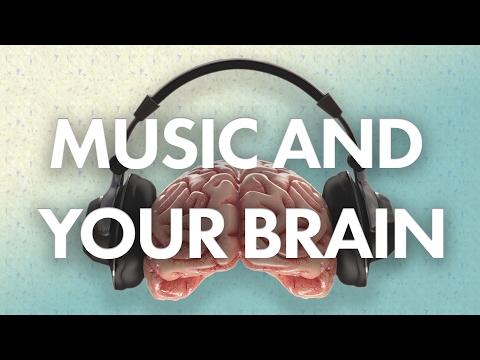
- Believe it or not, children with at least 3 years of musical training performed better during testing for nonverbal reasoning, fine motor skills, auditory discrimination, and
Believe it or not, children with at least 3 years of musical training performed better during testing for nonverbal reasoning, fine motor skills, auditory discrimination, and
- during testing for nonverbal reasoning,
during testing for nonverbal reasoning,