modal
US /ˈmodl:/
・UK /'məʊdl/
B2
adj.AdjectiveVerb like 'may' or 'can', showing a verb's mood
Both must and can are modal verbs
Video subtitles
Advanced Prepositions of Time: “throughout”, “ahead of”, “at around”, “out of”…

- Okay, yes, that was a tough one, because that could have been during the night, or, but remember we said apart when we talked about during, okay, and we said it's a part of a larger thing. When I talked about throughout, I said it can be to the end and maybe a bit before, a bit extra, a little bit extra. So, in this case, it was through the night, right? It went throughout the night and to the early morning, just a little bit extra. So, throughout is the correct answer here. What about number four? Josh is on his way home now. He should arrive around. Yeah, because this is should, right? We're looking at a modal here and it's like the right thing or kind of, so this modal tells us around, right? You should do something is like, it's the right thing to do. It doesn't mean you're going to do it, but it is the right thing to do. It's approximately, giving an approximation. In this case, when we said around, he should arrive. I think so. That's what he should do. Don't know. Maybe, maybe a little earlier, a little late. Through makes no sense here because you can't go through nine o'clock. You're not a car hitting a wall. Okay? And now finally, number five. The test was very difficult and I couldn't answer all of the questions. I, out of, ahead of time. What do you think? Sorry, time's up. What time now? I ran out of time. Ran out of. Remember? You have no more left. If you were ahead of time, that would be early, but you said it was very difficult and you couldn't answer. So clearly, you ran out of time. Cool? All right. So now we answer these questions and I hope to give you not just the answers to the questions, but the understanding that you have to look at context, showing you that different words can give you the word you want to use. Yeah?
Okay, yes, that was a tough one, because that could have been during the night, or, but remember we said apart when we talked about during, okay, and we said it's a part of a larger thing. When I talked about throughout, I said it can be to the end and maybe a bit before, a bit extra, a little bit extra. So, in this case, it was through the night, right? It went throughout the night and to the early morning, just a little bit extra. So, throughout is the correct answer here. What about number four? Josh is on his way home now. He should arrive around. Yeah, because this is should, right? We're looking at a modal here and it's like the right thing or kind of, so this modal tells us around, right? You should do something is like, it's the right thing to do. It doesn't mean you're going to do it, but it is the right thing to do. It's approximately, giving an approximation. In this case, when we said around, he should arrive. I think so. That's what he should do. Don't know. Maybe, maybe a little earlier, a little late. Through makes no sense here because you can't go through nine o'clock. You're not a car hitting a wall. Okay? And now finally, number five. The test was very difficult and I couldn't answer all of the questions. I, out of, ahead of time. What do you think? Sorry, time's up. What time now? I ran out of time. Ran out of. Remember? You have no more left. If you were ahead of time, that would be early, but you said it was very difficult and you couldn't answer. So clearly, you ran out of time. Cool? All right. So now we answer these questions and I hope to give you not just the answers to the questions, but the understanding that you have to look at context, showing you that different words can give you the word you want to use. Yeah?
- We're looking at a modal here, and it's like the right thing or kind of.
We're looking at a modal here, and it's like the right thing or kind of.
These are the AI to Worry About

- First is AI's multi-modal agent that is due to release this month.
First is AI's multi-modal agent that is due to release this month.
The $11B Tunnel That Could Save One of Europe’s Busiest Mountain Corridors | WSJ Breaking Ground

- Italy did not respond to requests for comment, but at the root of this is Austria's desire for a modal shift from highway to railway.
Italy did not respond to requests for comment, but at the root of this is Austria's desire for a modal shift from highway to railway.
- but at the root of this is Austria's desire for a modal shift from highway to railway.
but at the root of this is Austria's desire for a modal shift from highway to railway.
IMPERATIVES – How to give commands in English

- a form of a modal. But it's the rare exception. Okay?
a form of a modal. But it's the rare exception. Okay?
- and they're using a form of a modal, but it's the rare exception.
and they're using a form of a modal, but it's the rare exception.
? How to Think in English and Stop Translating in Your Head (4 Ways!)
- Do we need to know that when we use can in a question, we invert the pronoun and that the modal verb can comes before the main verb have and that we don't need a preposition with the word can?
Do we need to know that when we use can in a question, we invert the pronoun and that the modal verb can comes before the main verb have and that we don't need a preposition with the word can?
- Do we need to know that when we use can in a question, we invert the pronoun and that the modal verb can comes before the main verb have and that we don't need a preposition with the word can?
Do we need to know that when we use can in a question, we invert the pronoun and that the modal verb can comes before the main verb have and that we don't need a preposition with the word can?
Learn CONTINUOUS TENSES in English the EASY way!
- is we've added the modal of "will" or "won't", and we've got "be" plus verb+ing. Again, it's
is we've added the modal of "will" or "won't", and we've got "be" plus verb+ing. Again, it's
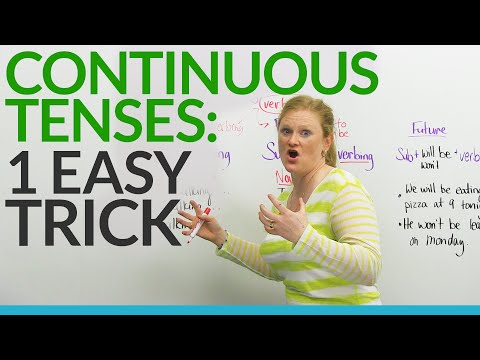
- So, the only thing that changes here is we've added the modal of "will" or "won't," and we've got "be" plus verb plus "ing." Again, it's really important to never change the "be." You cannot say: "She will am going." You can never change the "be" verb here.
So, the only thing that changes here is we've added the modal of "will" or "won't," and we've got "be" plus verb plus "ing." Again, it's really important to never change the "be." You cannot say: "She will am going." You can never change the "be" verb here.
Grammar: Learn to use REPORTED SPEECH in English

- or the modal "will" to "would". So it's going to change to: "She would go". That's cool.
or the modal "will" to "would". So it's going to change to: "She would go". That's cool.
- Future simple: "She will go." All we're going to do is change the verb or the modal "will" to "would." So, it's going to change to: "She would go." That's cool.
Future simple: "She will go." All we're going to do is change the verb or the modal "will" to "would." So, it's going to change to: "She would go." That's cool.
English Modal Verbs - How to Use 'Should', 'Ought to', 'Supposed to' and 'Had Better'

- In this lesson, you can learn how to use the modal and semi-modal verbs 'should', 'ought
In this lesson, you can learn how to use the modal and semi-modal verbs 'should', 'ought
- In this lesson, you can learn how to use the modal and semi-modal verbs "should", "ought to", "had better",
In this lesson, you can learn how to use the modal and semi-modal verbs "should", "ought to", "had better",
Future in English - How to Talk about the Future

- You can use a modal verb like 'may', 'might', or 'could'.
You can use a modal verb like 'may', 'might', or 'could'.
- You can use a modal verb like may, might or
could.
You can use a modal verb like may, might or could.
Tips To Improve Your Grammar! English Auxiliary Verbs | BE, DO & HAVE

- Modal verbs are also considered auxiliary verbs, but there are different grammar rules for modal verbs.
Modal verbs are also considered auxiliary verbs, but there are different grammar rules for modal verbs.
- Modal verbs are also considered auxiliary verbs
Modal verbs are also considered auxiliary verbs