evoke
US /ɪˈvok/
・UK /ɪ'vəʊk/
B1TOEIC
v.t.Transitive VerbTo bring forth a certain feeling or memory
If you evoke his anger do not be surprised if he breaks something
Video subtitles
The Mark of True Love...
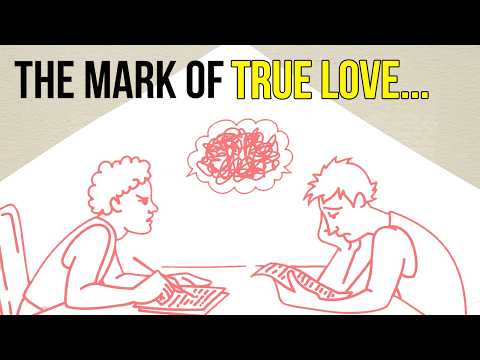
- We humans have an immense appetite for complicated things, neuroscience, astrophysics and molecular biology of course, but also barely decipherable books, abstract works of art and avant-garde pieces of theatre without plot or character, all of which perhaps evoke the primordial puzzles of the universe and our own always ineffable existence within it. But our veneration for complexity can reach a most painful, time-consuming and futile zenith in one area in particular – relationships. It's here that we find otherwise discerning and hard-headed people exhibiting extreme patience, often lasting over a succession of tormented years, for what we can call complicated situations. The complexities may arise from some of the following dynamics. A beloved partner who wants to commit and surely will one day but not quite yet on account of this or that factor or not entirely because of certain psychological fears or not conclusively or at least not without certain important caveats. They may need space, freedom or what they call a chance to explore though quite what was still not wholly clear, though we have asked them on many occasions. Then a partner with whom there are a lot of misunderstandings, around whom words often lose their standard meanings, around whom we may have to spend hours untangling what was truly meant and around whom gestures or deeds that we previously thought uncontentious suddenly become the occasion for major surprising aggravations. Or a partner who in principle is there for us and in theory loves us very very much but in actuality – like last week and the week before that – is constantly remarkably busy, unable to respond to our texts, out with their compelling friends or concentrated on their always extremely demanding job. Or a partner with whom we sit up late at night on many occasions with a pad and paper to hand attempting to determine where the issues are coming from, what is at play and how things might be handled before, baffled and upset, we finally have to retreat to bed a little after 1am feeling fragile and tearful.
We humans have an immense appetite for complicated things, neuroscience, astrophysics and molecular biology of course, but also barely decipherable books, abstract works of art and avant-garde pieces of theatre without plot or character, all of which perhaps evoke the primordial puzzles of the universe and our own always ineffable existence within it. But our veneration for complexity can reach a most painful, time-consuming and futile zenith in one area in particular – relationships. It's here that we find otherwise discerning and hard-headed people exhibiting extreme patience, often lasting over a succession of tormented years, for what we can call complicated situations. The complexities may arise from some of the following dynamics. A beloved partner who wants to commit and surely will one day but not quite yet on account of this or that factor or not entirely because of certain psychological fears or not conclusively or at least not without certain important caveats. They may need space, freedom or what they call a chance to explore though quite what was still not wholly clear, though we have asked them on many occasions. Then a partner with whom there are a lot of misunderstandings, around whom words often lose their standard meanings, around whom we may have to spend hours untangling what was truly meant and around whom gestures or deeds that we previously thought uncontentious suddenly become the occasion for major surprising aggravations. Or a partner who in principle is there for us and in theory loves us very very much but in actuality – like last week and the week before that – is constantly remarkably busy, unable to respond to our texts, out with their compelling friends or concentrated on their always extremely demanding job. Or a partner with whom we sit up late at night on many occasions with a pad and paper to hand attempting to determine where the issues are coming from, what is at play and how things might be handled before, baffled and upset, we finally have to retreat to bed a little after 1am feeling fragile and tearful.
- All of which perhaps evoke the primordial puzzles of the universe—and our own, always ineffable existence within it.
All of which perhaps evoke the primordial puzzles of the universe—and our own, always ineffable existence within it.
Biblical Series I: Introduction to the Idea of God

- Is it possible for something that's incredibly beautiful to evoke a religious or mystical experience, or something in the same ballpark?
Is it possible for something that's incredibly beautiful to evoke a religious or mystical experience, or something in the same ballpark?
- Is it possible for something that's incredibly beautiful to evoke a religious or mystical experience or something kind of in the same ballpark as that?
Is it possible for something that's incredibly beautiful to evoke a religious or mystical experience or something kind of in the same ballpark as that?
What Is The Treachery of Images?

- Ideas his program was to confuse to evoke mystery to show us that what we want is always
Ideas his program was to confuse to evoke mystery to show us that what we want is always
- His program was to confuse, to evoke mystery, to show us that what we want is always behind the thing we see,
His program was to confuse, to evoke mystery, to show us that what we want is always behind the thing we see,
Permafrost Is Not What You Think It Is

- Permafrost may evoke an image of barren, lifeless tundra, but that's another misconception.
Permafrost may evoke an image of barren, lifeless tundra, but that's another misconception.
- Permafrost may evoke an image of barren, lifeless tundra, but that's another misconception.
Permafrost may evoke an image of barren, lifeless tundra, but that's another misconception.
Control Your Tone: Fix Vocal Fry, Whisper, and Upspeak for a Stronger Voice

- So let's talk about three different tones of voice that I'm going to say evoke strong emotions in people.
So let's talk about three different tones of voice that I'm going to say evoke strong emotions in people.
- So let's talk about three different tones of voice that I'm going to say evoke strong emotions in people.
So let's talk about three different tones of voice that I'm going to say evoke strong emotions in people.
France brings back limited military service with 3,000 volunteers | BBC News

- And then there's this other thing which needs to be factored in, which is that this is not Macron's first bid to sort of tap into the spirit of engagement which he likes to evoke among young people.
And then there's this other thing which needs to be factored in, which is that this is not Macron's first bid to sort of tap into the spirit of engagement which he likes to evoke among young people.
- then there's this other thing which needs to be factored in, which is that, you know, this is not Macron's first, um, bid to sort of tap into the spirit of engagement, which he likes to evoke among young people.
then there's this other thing which needs to be factored in, which is that, you know, this is not Macron's first, um, bid to sort of tap into the spirit of engagement, which he likes to evoke among young people.
How Politics Can Drive Us Mad

- Nazism. After all, none of Hitler's furious speeches targeted her. No Luftwaffe raid gunned for her. And yet, in a sense, the atmosphere of mayhem and unbounded violence generated by Hitler and his gang were to blame for unbalancing the fragile mind of possibly the greatest writer of the 20th century, living in a quiet English village far from any bomb or concentration camp. Woolf's case stands as a warning and a reminder of susceptibility. For those of us who are not wholly steady inside, whose minds have been placed under enormous stress by early losses and abuses, what happens in the political realm is not as distinct from us as it might be and may prove especially charged and especially dangerous. The hateful voices and motives we see far away can't help but evoke those we have known too well from our vicinity and that we have fought for many years to keep at bay. We may have a special need, more than we realised, for the world to show evidence of solidity and goodness to counterbalance the violations of the past. If we find ourselves so-called abnormally affected, if the shouting and the hate and the betrayals and the viciousness cut deep into our minds, we need to take particular care. We may need to fight with extra courage and assiduously enlist the love of all who care about us, to remain on the side of hope, to ensure that all that is unkind outside of us is never allowed to achieve a victory over the wisdom and goodness that endure within us.
Nazism. After all, none of Hitler's furious speeches targeted her. No Luftwaffe raid gunned for her. And yet, in a sense, the atmosphere of mayhem and unbounded violence generated by Hitler and his gang were to blame for unbalancing the fragile mind of possibly the greatest writer of the 20th century, living in a quiet English village far from any bomb or concentration camp. Woolf's case stands as a warning and a reminder of susceptibility. For those of us who are not wholly steady inside, whose minds have been placed under enormous stress by early losses and abuses, what happens in the political realm is not as distinct from us as it might be and may prove especially charged and especially dangerous. The hateful voices and motives we see far away can't help but evoke those we have known too well from our vicinity and that we have fought for many years to keep at bay. We may have a special need, more than we realised, for the world to show evidence of solidity and goodness to counterbalance the violations of the past. If we find ourselves so-called abnormally affected, if the shouting and the hate and the betrayals and the viciousness cut deep into our minds, we need to take particular care. We may need to fight with extra courage and assiduously enlist the love of all who care about us, to remain on the side of hope, to ensure that all that is unkind outside of us is never allowed to achieve a victory over the wisdom and goodness that endure within us.
- The hateful voices and motives we see far away can't help but evoke those we have known too well from our vicinity and that we have fought for many years to keep at bay.
The hateful voices and motives we see far away can't help but evoke those we have known too well from our vicinity and that we have fought for many years to keep at bay.
Digital Brushwork - 10 Minutes To Better Painting - Episode 3

- I still need to evoke that emotion on an abstract level, the brushwork level.
I still need to evoke that emotion on an abstract level, the brushwork level.
- I still need to evoke that emotion on an abstract level, the brushwork level.
I still need to evoke that emotion on an abstract level, the brushwork level.
HISTORY OF IDEAS - Wabi-sabi

- He also stresses that one should abandon the perfect and lustrous tea-drinking cups of the Chinese, which seem to evoke the flawlessness of a full moon,
He also stresses that one should abandon the perfect and lustrous tea-drinking cups of the Chinese, which seem to evoke the flawlessness of a full moon,
- which seem to evoke the flawlessness of the full moon,
which seem to evoke the flawlessness of the full moon,
Hyperbole

- may be used to evoke strong feelings or to create a strong impression, but is not meant
may be used to evoke strong feelings or to create a strong impression, but is not meant
- It may be used to evoke strong feelings or to create a strong impression,
It may be used to evoke strong feelings or to create a strong impression,