convolutional
US
・UK
A1
adj.AdjectiveRelating to or involving convolution, especially in mathematics or signal processing.
Convolutional neural networks are widely used in image recognition.
adj.AdjectiveUsing convolution operations; often refers to a type of artificial neural network.
The convolutional layer extracts features from the input image.
Video subtitles
Cell Instance Segmentation for Automated quantifcation of HER2 amplification levels
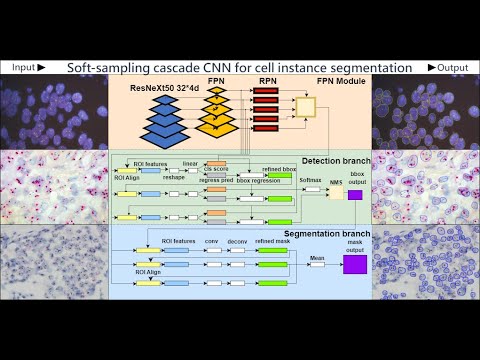
- A the FBN module with orange background color shows two concepts of top down sampling and skip connection to extract the intermediate convolutional feature Zeta using ResNext T50 as the backbone network.
A the FBN module with orange background color shows two concepts of top down sampling and skip connection to extract the intermediate convolutional feature Zeta using ResNext T50 as the backbone network.
- This is main architecture of the proposed method: a) the FPN module with orange background color shows 2 concepts of top-down sampling and skip-connection to extract the intermediate convolutional feature zeta using ResNext T50 as the backbone network.
This is main architecture of the proposed method: a) the FPN module with orange background color shows 2 concepts of top-down sampling and skip-connection to extract the intermediate convolutional feature zeta using ResNext T50 as the backbone network.
Transformers, explained: Understand the model behind GPT, BERT, and T5

- Like if you're analyzing images, you'd typically use a convolutional neural network, which is designed to vaguely mimic the way that the human brain processes vision.
Like if you're analyzing images, you'd typically use a convolutional neural network, which is designed to vaguely mimic the way that the human brain processes vision.
- Like if you're analyzing images, you'd typically use a convolutional neural network, which is designed to vaguely mimic the way that the human brain processes vision.
Like if you're analyzing images, you'd typically use a convolutional neural network, which is designed to vaguely mimic the way that the human brain processes vision.
Building the future of artificial intelligence for everyone (Google I/O '18)

- And one of the teams from Toronto, which is now at Google, won the ImageNet Challenge with the deep learning convolutional neural network model.
And one of the teams from Toronto, which is now at Google, won the ImageNet Challenge with the deep learning convolutional neural network model.
- with the deep learning convolutional neural network
with the deep learning convolutional neural network
Machine Learning: Google's Vision - Google I/O 2016

- For an image problem, I should use convolutional neural nets.
For an image problem, I should use convolutional neural nets.
- For an image problem, I should use convolutional neural nets,
For an image problem, I should use convolutional neural nets,
Should We Let Robots Take Our Jobs?

- They did this using something called a deep convolutional neural network,
They did this using something called a deep convolutional neural network,
- They did this using something called a deep convolutional neural network and trained it
They did this using something called a deep convolutional neural network and trained it
Use Cases - Ep. 12 (Deep Learning SIMPLIFIED)

- Clarify is an app that uses a convolutional net to recognize things and concepts in a digital image.
Clarify is an app that uses a convolutional net to recognize things and concepts in a digital image.
- description below. Clarifai is an app that uses a convolutional net to recognize things
description below. Clarifai is an app that uses a convolutional net to recognize things
When Will Artificial Intelligence Replace Radiologists? 🤖
- These models rely on artificial neural networks, typically a specific type called a convolutional neural Network, or CNN.
These models rely on artificial neural networks, typically a specific type called a convolutional neural Network, or CNN.
- These models rely on artificial neural networks, typically a specific type called a convolutional neural network or CNN.
These models rely on artificial neural networks, typically a specific type called a convolutional neural network or CNN.
4 Ways Artificial Intelligence is Transforming Healthcare

- For example, the Convolutional Neural Network, or cnn, is a diagnostic modality that can analyze thousands of images from public datasets and patient medical records to identify patterns, enabling them to quickly and accurately diagnose diseases.
For example, the Convolutional Neural Network, or cnn, is a diagnostic modality that can analyze thousands of images from public datasets and patient medical records to identify patterns, enabling them to quickly and accurately diagnose diseases.
- For example, the Convolutional Neural Network, or CNN, is a diagnostic modality that can analyze thousands of images from public datasets and patient medical records to identify patterns, enabling them to quickly and accurately diagnose diseases.
For example, the Convolutional Neural Network, or CNN, is a diagnostic modality that can analyze thousands of images from public datasets and patient medical records to identify patterns, enabling them to quickly and accurately diagnose diseases.
The AI-powered Era of Scientific Discovery Is Here - Ep. 25 with Dr. Bradley Love

- Whereas, you know, previous generations of machine learning models, even the great, like, you know, convolutional models that somewhat cracked object recognition or—or like AlphaGo, uh, you know, doing—you know, doing its games and so forth, like, um, those are, um, you know, specialized models.
Whereas, you know, previous generations of machine learning models, even the great, like, you know, convolutional models that somewhat cracked object recognition or—or like AlphaGo, uh, you know, doing—you know, doing its games and so forth, like, um, those are, um, you know, specialized models.
- And I mean, in some sense, why we're so excited everyone's so excited about large language models is that they're, like, you know, base or foundational in some sense, that you could apply them to other tasks, not just the tasks they're trained on, whereas, you know, previous generations of machine learning models, even the great, like, you know, convolutional models that somewhat cracked object recognition or, or, like, AlphaGo, uh, you know, doing, you know, doing its games and so forth.
And I mean, in some sense, why we're so excited everyone's so excited about large language models is that they're, like, you know, base or foundational in some sense, that you could apply them to other tasks, not just the tasks they're trained on, whereas, you know, previous generations of machine learning models, even the great, like, you know, convolutional models that somewhat cracked object recognition or, or, like, AlphaGo, uh, you know, doing, you know, doing its games and so forth.